Renaras
The Kin-michi Bijin — Japanese Ceremonial Silk Wall Tapestry, Court Figures in Tsuzure-Ori Gold
The Kin-michi Bijin — Japanese Ceremonial Silk Wall Tapestry, Court Figures in Tsuzure-Ori Gold
Couldn't load pickup availability
Free shipping across Europe, 3–5 business days. Worldwide delivery available.
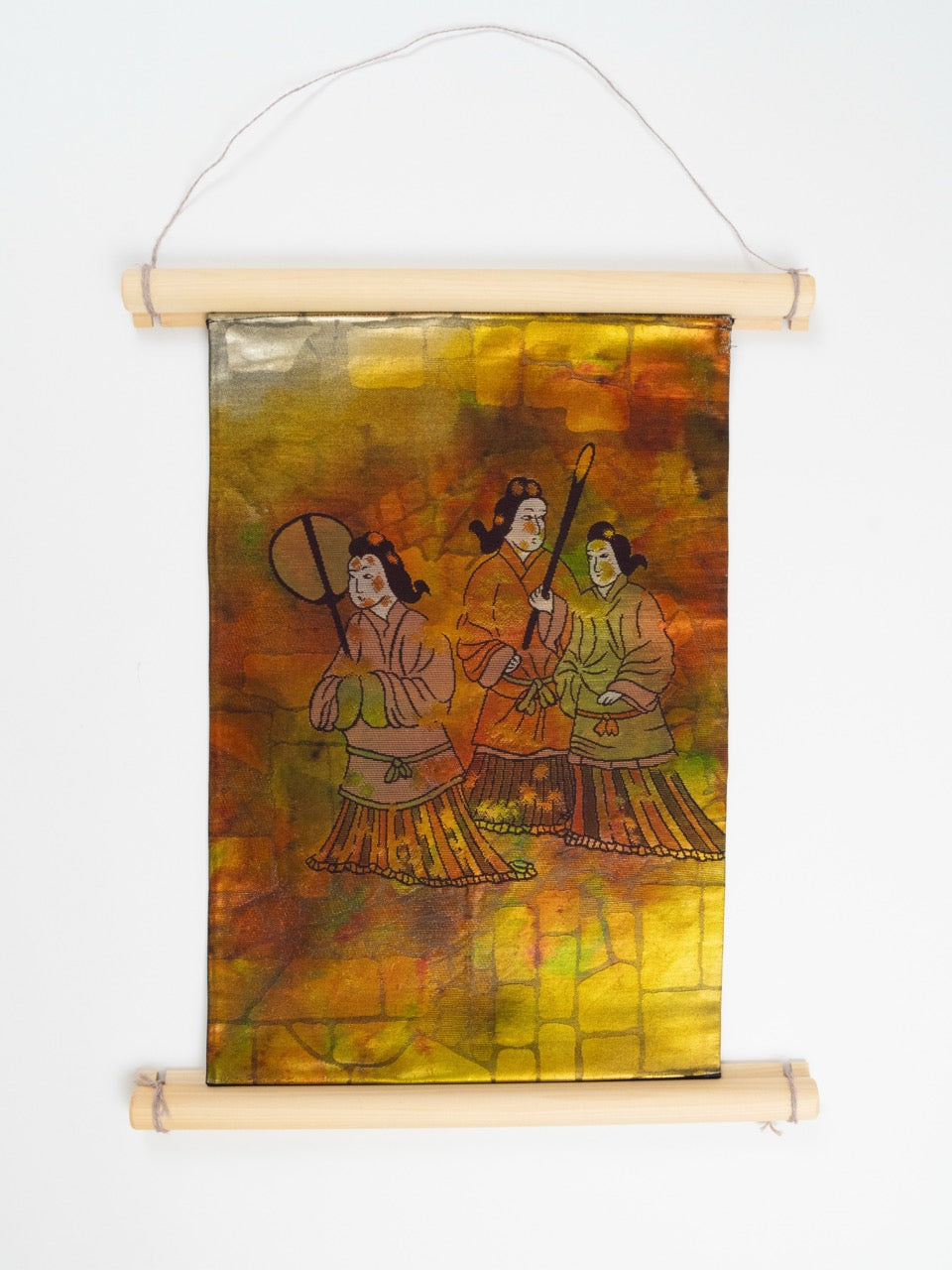
Three court figures. A golden road. The only Bijin-ga in the collection.
At a glance: A single obi in tsuzure-ori tapestry weave, three court figures on a gold road, mounted between hardwood bars at about 100 × 35 cm. The only bijin-ga in the Renaras collection; one exists. Japanese ceremonial silk, finished at the Renaras atelier, Amsterdam; ships worldwide.
The Kin-michi Bijin is mounted from a Japanese ceremonial silk obi woven in Tsuzure-ori (綴れ織り) — the most labour-intensive and pictorially precise of all Nishijin weave constructions, in which each colour area is built individually by a weaver working the weft thread back and forth across only the portion of the warp it belongs to, producing a textile structurally closer to a European tapestry than to conventional silk weaving, and that achieves a resolution and tonal depth no other loom technique can match. The ground is deep Kinran gold and rusted orange, worked with a painterly atmospheric dye effect that reads like firelight, or the particular quality of late afternoon sun on a dusty road — the ground is not flat but in motion, the colours shifting and bleeding into one another. Against this ground three Bijin-ga (美人画) court figures move in procession, each carrying a parasol, their robes rendered in the muted green and brown that Japanese court painters used to place figures in time. The Tsuzure construction means each figure is built thread by thread with the patience of a painter rather than the speed of a weaver — the robes, the parasols, the hands, the angle of each head are individual decisions at the loom.
At the atelier we cut a length from the Tsuzure obi, redesigned the composition for vertical wall format, and lined the back with undyed support cloth. The piece is mounted between handmade hardwood bars at the top and bottom, finished with a leather hanging cord, and supplied ready to hang. The bars are part of the work, not a separate acquisition. The visible silk is the obi as it was woven.
The Kin-michi Bijin is the most narratively rich piece in the collection — the one that rewards extended looking, that carries a story rather than a motif. The deep gold and rusted orange palette works with dark walnut, aged bronze, terracotta plaster, warm ivory and the full range of interiors furnished in considered warm materials. It belongs in a principal room where it will be seen every day and will not be the same piece twice — the drawing room of a private residence, the entrance of a fine restaurant, the gallery space of a serious hotel.
Renaras: existing Japanese ceremonial silk, preserved at gallery scale and brought into rooms where it can be seen.
Each tapestry arrives with its own passport from the atelier — a handmade record of the obi's first life, the composition that was cut from it, the lining and mounting it received, signed and dated in Amsterdam.
| Product type | Wall tapestry |
|---|---|
| Silk source | Japanese ceremonial silk, Tsuzure-ori (綴れ織り) tapestry weave on Kinran gold and rusted orange ground |
| Weave / technique | Tsuzure-ori tapestry weave with painterly atmospheric dye ground |
| Construction | Cut and redesigned from a Japanese ceremonial silk obi, lined to support the silk threads, mounted on handmade hardwood bars and finished with a leather hanging cord. Bars and cord supplied. No metal touches the visible silk |
| Dimensions | 100 × 35 cm, displayed |
| Origin of silk | Japan |
| Assembled in | Amsterdam, Netherlands |
| Care | Dust with a soft brush; keep out of direct sunlight |
| Unrepeatable | Yes |
| SKU | REN-TEN-001-D |
Each tapestry arrives complete with its mounting hardware. For private viewings and hospitality enquiries, contact the atelier.
One silk. One story. One piece. Never repeated.
Share
Shipping
Shipping
Free shipping across Europe. Delivered within 3–5 business days. International shipping available — contact us for rates. All pieces are wrapped individually in tissue and despatched in a rigid, protective box.
Returns
Returns
Returns accepted within 14 days of receipt, provided the piece is returned in its original condition. As every textile is singular and unrepeatable, we ask that pieces are handled with care. Please contact us before returning. Read the full returns policy.
Care
Care
Spot clean only — these are ceremonial silks, not washable textiles. Avoid prolonged direct sunlight to preserve the depth of colour. The envelope pocket closure requires no zip or metal clasp touching the silk: this is intentional. Mottainai — nothing wasted, nothing forced.